Winterizing I/O with engine mounted sea water pump

ddurand

Member
Member
Joined
Jun 20, 2001
RO Number
5015
Messages
837
I got a Camco winterization kit which is a 5 gal container with some hoses and fittings and valves.

The instructions said to use muffs if the sea water pump is in the outdrive and a Camco adapter to connect the hose to the sea water pump intake if the sea water pump is engine mounted. The Camco adapter needs to be separately purchased.

Not sure why they suggest the muffs cannot be used with an engine mounted sea water pump.
 
I think if your pump is engine mounted it’s intake is via a thru hull vs the outdrive.
 
That may not be the case with Bravo's. I seem to recall a belt driven raw water pump with an input through the drive.
 
My Volvo Penta has the sea water intake in the outdrive and an engine mounted sea water pump.
 
1) if you’re raw water cooled you must either drain the water first or remove the thermostat or else risk a cracked block. If you’re closed cooled then yes you can use this method BUT:
2) gravity flow will not feed an engine mounted impeller the AF has to travel up 18” from the water intakes and then about 31/2’ forward to the impeller housing. The only way that can be made to work is to adapt an electric pump like a live well pump to the tank to pressurize the flow.
Gravity flow will work on an outdrive with the impeller mounted in the lower unit like the Merc Alpha. Not on Volvos or Bravos.

Impellers do not suck water when the cooling hoses are full of air; the liquid has to make it all the way to the impeller for them to work.
 
It seems to me there is move gravity pulling the antifreeze from the 5 gallon container in the swim platform than there would be pulling water in from the ocean or lake if boat was sitting in the water.

What about the garden hose flush adapter on my VP engine that is near the sea water pump intake?
 
When the boat is in the water it is hydrostatic pressure because all the raw water hoses are below the static water line of the boat. The impeller doesn't have to pull it in with the boat in the water, the water pressure against the hose, will push it into the boat just like it would if you got a hole in the boat. If you tried to replace an impeller with the boat in the water and didn't plug that hose, or tie it up above the water line you'd find this out the hard way lol.
You will never get gravity flow on land from the swim platform to the impeller housing and will burn up the impeller. The garden hose flush adapter idea could work if you can route the hose so it doesn't have any low spots to interrupt the flow. The other way, is to adapt an electric pump to that tank. I adapted a live well pump to mine, to use as a drum brake flusher.
 
When the boat is in the water it is hydrostatic pressure because all the raw water hoses are below the static water line of the boat. The impeller doesn't have to pull it in with the boat in the water, the water pressure against the hose, will push it into the boat just like it would if you got a hole in the boat. If you tried to replace an impeller with the boat in the water and didn't plug that hose, or tie it up above the water line you'd find this out the hard way lol.
You will never get gravity flow on land from the swim platform to the impeller housing and will burn up the impeller. The garden hose flush adapter idea could work if you can route the hose so it doesn't have any low spots to interrupt the flow. The other way, is to adapt an electric pump to that tank. I adapted a live well pump to mine, to use as a drum brake flusher.
So what is the best solution when one has an engine mounted sea water pump? Some kind of electric pump to pump the antifreeze in ?
 
I always used a bilge pump and battery.
 
For carb`d engines
flush and fog unitl engine stalls
pull drain plugs and probe to insure draining
remove large hose from therm housing and pour AF in until it comes out the housing, reattach hose
Do the same for manifolds and risers.
pull drains, probe to insure draining pour AF in hoses , about 3/4 of a gallon in each

To use any other method ,you need to drain everything first or you stand a good chance of a cracked block
 
That may not be the case with Bravo's. I seem to recall a belt driven raw water pump with an input through the drive.
Yep. I haven’t messed with outdrives since the mid-2000’s or so, but that definitely was the case with Bravos.
 
For carb`d engines
flush and fog unitl engine stalls
pull drain plugs and probe to insure draining
remove large hose from therm housing and pour AF in until it comes out the housing, reattach hose
Do the same for manifolds and risers.
pull drains, probe to insure draining pour AF in hoses , about 3/4 of a gallon in each

To use any other method ,you need to drain everything first or you stand a good chance of a cracked block
This is a closed cooling engine. So no engine or exhaust manifold to worry about.
 
I recently came across the instructions on how to drain the sea water side. Maybe that would be the better way forward?
 
The “muffs” should work well enough, especially for a closed cooled motor. Or drain it, really can’t go wrong with closed cooling - you would have to try pretty hard to damage the risers ( or coolers) with freeze damage. an adapter on the input line sounds nice, but in my opinion just one more potential failure point added to the system. Some people, more responsible than me, flush their motor after every saltwater trip. In that case, I would consider hacking up my intake. But for once a year? Probably not.

I did it with muffs for many years - until I gave up on my bravo drive design getting water through the drive and I installed a transom scoop. Never had a problem. I used to sit the tank of antifreeze high up, above the motor, so it had some pressure going up into the drive, and did not entirely depend on the pump to pull it through.

I should probaby note that before I switched to a transom scoop I always used globe ‘run dry’ impellers in my boat - so perhaps muffs would not have worked with an oem impeller. https://www.globemarinedirect.com/Impellers-s/176.htm

and tell us more about your kit. If I recall, mine had a Y diverter - so I would run off a hose for a bit to warm the oil, and that pressure would prime the pump / keep the intake hose filled with water - then I would switch the diverter, with engine running, to draw from the coolant tank. If I tried to do it with just the muffs/tank, as mentioned by others above, could never get the pump primed.
 
Last edited:
You can just drain it, as long as all the plugs come out.
 
  • Like
Reactions: alk
I was thinking before I drain the engine I would run some Salt-Off through the engine to remove any salt that may be in the sea water side. Some of my testing for the overheat situation I had was at the dock in salt water.
 
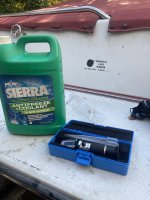
On my old raw water cooled engine all I have ever done is drain everything manually, poke all the holes and then back fill the engine, manifolds and raw water intake hose with PG antifreeze. I used to use the -100 West Marine stuff but it's pretty expensive so now I mix up a batch of Sierra PG antifreeze 50/50 with water that gives -26*F freeze protection. This is good enough to use as an engine coolant, and it's cheaper than the WM -100 stuff by about $7 a gallon. You do need to use an antifreeze refractometer to make sure your mix is accurate. antifreeze & refractometer.jpg
 
The newer boats with closed system cooling make it easier and harder to winterize at the same time. No block or exhaust manifolds to worry about but one does need to worry about oil cooler, fuel cooler, heat exchanger and risers and a engine mounted sea water pump.

I would winterize my old Mercruiser Alpha One the way you suggest.
 
One last thing I did or came across. The raw water hose I pulled off the raw water pump going to the outdrive also cools the oil cooler on the way in I believe. I brought some pink stuff to pour down that hose and hopefully run out of the intake in the outdrive. Poured a little pink stuff in and it would not take much and realized the hose went uphill along it's path to the transom. So I used an old school trick and just blew into the hose and cleared the hose of water and/or pink stuff. Did that a few times adding a little pink stuff each time. Probably not needed but made me feel good about winterizing the engine. Sometimes it's the simple things that work the best.
 
Last edited:
Yep after a while you figure out all the little tricks that work with the set up you have.
 
Back
Top