Chevy 350 - Water in oil

To clarify some points to Zane and Jtybt15 -

1. The crossover I was referring to was just the 'crossover' in the intake manifold itself, not the crossover on the front of the block which would replace the circulating pump. In other words, the connecting point from the left head to the right head.

2. The motor does in fact lack a circulating water pump, although I never did mention that piece of info. The motor just runs a raw water pump which circulates water through the block. Like Zane mentioned, this could contribute to an overheat condition. I found a post from the seller that said he was having trouble with the engine running hot and people responded that for those running a crossover, that requires a couple of holes to be drilled in the thermostat so that constant circulation occurs.

3. The compression checked out fine at 175? (I recall) in every cylinder.

4. We could not visually see any cracks in the cylinder walls or the deck surface.

5. My buddy dropped the heads off today at the machine shop. He said he should have an answer by Friday.

At this point I'm leaning towards trying to throw the motor back together even if the heads check out OK. I believe we would be into it with the pressure check on the heads and new gaskets about $250. I'm confident on my ability to reassemble and if issues still occur, it must be with the block. My buddy is pushing towards a new motor now to just be done with it, but I'm not confident what the exact cause of the issue(s) were and I would hate to ruin a new motor.
 
quote:

Originally posted by jtybt15

I'm a bit curious how water/rust got in the intake. You talkin' about the heads runners or intake manifold.

This is really one of those cases that need visual inspection to see what's going on. How much experience did the previous owner/builder have with marine engines? My first engine rebuild I had the heads done my a friends machine shop. Surrrrre, he knew how to build a marine engine. ALL the exhaust valves got 'sucked'.


It was rust in the intake port in the head, not the intake manifold itself. Again, how this happened is beyond me. The seller seems very hesitant to tell the entire story. At this point it wouldn't make a difference because my buddy already purchased the boat. I just wish he could throw us a bone to help guide us on the fix. I don't think the previous owner had a ton of engine experience. He was able to follow the manual and got it apart and fully reassembled and running. Not that it means much, but he had to have had some common sense.
 
Engines are 350 Chevys with TRS drives. Basically stock rebuilds with a crane cam. The motors are probably around 300hp. The engine runs fine... it just has a ton of water in the oil.
 
TRS drives? Are those the ones with the tranny inside the boat? The TR series were the fore-runners to the bravo series (BII). HEAVY DUTY!!

I'm not familiar with the TR drives or the raw water intake. Is the raw water pump on the engine?...bravo style pump? or in the drive itself.

Anyway, what I'm getting at is the different possibilities of over-heating. One of the most important points is the water hose between the drive and the transom. It HAS to be the correct length. Best check if it kinks with the drive all the way down.

The bravo ans TR series drives run the hottest and require intake water running thru the drive. Should also have drive showers on them.

Now the other part that could be causing over-heating. The intake hose from the drive to the pump is very restrictive. You should add a thru hull raw water pick-up. This way, there's always water getting to the pump, even if one inlet gets blocked off by 'debris'.

I swapped an alpha for a BII OD but I already had the extra thru hull pick-up. I also have a home-made drive shower the puts out so much water, it obscures the drive under way. Over-heat and water intrusion are the biggest killers of marine engines.

...and I'm with you, no use putting in a new engine til you find the cause of the over-heat and water intrusion. Could be rusted thru block or even cracked water jacket that's not readily visable.
 
Yes, the TRS drives have the trans inside the boat. They are heavy duty.

I do believe there is a thru-hull for raw water pickup and the pump is mounted on the engine. The overheat was fixed by drilling holes in the thermostat. Like Zane mentioned, the crossover tube causes air pockets since no circulating pump is present. This is fixed by drilling holes in the Tstat so that water is constantly flowing. Like I said, I'm pretty sure the overheat issue is fixed. The real issue at hand is the water in the oil.
 
Well the heads are at the shop now getting checked.

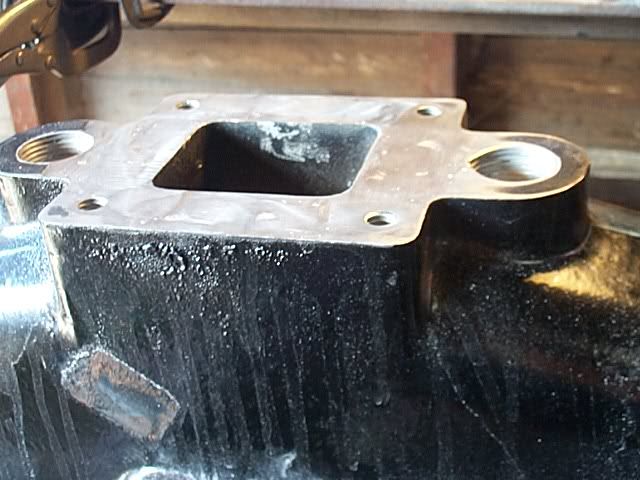
My buddy also bead blasted the risers/manifolds. He said the surfaces looked horrible. I will probably throw them in the bridgeport and take a couple passes off to clean them up. He made up plates to pressure check them as well.

We will figure this problem out somehow!
 
It's generally not worth trying to save the manifolds or risers if they've been on long enuff to compromise the mating surfaces. They're thin enuff even new. One of the problems is the castings and the machining process. There's just too much chance of the walls/mating surfaces not lining up in an already thin clamping surface.

Take a look at my last entry in this thread...

http://www.boatered.com/forum/topic.asp?TOPIC_ID=152855

and this is a look at the welded up aluminum manifold

002-9.jpg


and the base plate of the 'riser' section

001-10.jpg


Oh, in case your friend is interested, I still have the welded up cast iron manifolds and risers. They're in great shape and were not on that long before I went to the SS exhaust and aluminum manifolds.
 
I've seen that picture before. Nice setup there. I will keep you in mind after I do an inspection on the pieces myself.
 
Ok I forget what update number this is, but anyhow.... machine shopped called and here are the results...

1. 0.002" out on the deck surface. The deck surface was classified as 'rough'.

2. Pressure tested ok - No cracks

3. 5 cylinders vacuum was low. The one cylinder that had a valve replaced was as low as 20%.

I don't think a deck surface which is out 0.002" would cause a head gasket leak, but I guess it's possible. I still can not determine whether these results were the sole contributor or a partial contributor to water in the oil.

Currently he's in the hole $125 for the cleanup/pressure check. They're obviously suggesting a valve job and to deck the surface. I think total for everything he's in the $485 range. For basically another $1000 bucks and he has a new motor. I guess we could also go and buy a used set of heads from the junk yard off a truck motor and bolt them on? That might set us back another $200-$250, but of course that is a gamble as well.

Thoughts?
 
i know its been over a year but i never read the solution. i am going thru same thing now with same 350 and same heads. mine started when apparently my fuel pump went out with my son and he had drove 50 miles with a bunch of friends to ski and the idea of just coming back home did not appeal to him. he did not know what the problem was and tried starting fluid and got a nice backfire and damaged one head. it was replaced and i have torn apart twice looking for reason water getting in oil.
 
Heck, I missed dl's last comment. I would have recommended getting a set of vortec heads. They used to cost less than a valve job. They're still the best buy.

There are so many ways water can get into the oil. The more info provided helps narrow down the possible causes.
 
Back
Top