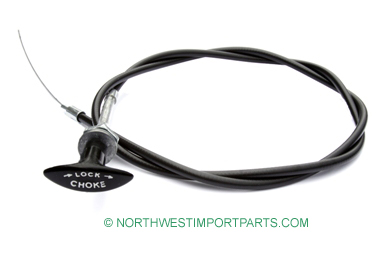
Divorce choke replacement

Bruce Herrington

Well-known member
Member
Joined
Jan 1, 2000
RO Number
2612
Messages
851
The choke coil on port engine caused a little grief yesterday. Does anyone know of a better alternative than merely replacing original part?

Carb works fine, except for choke issue.

Thanks.. :-)
 
BHH2064-L.jpg


Don't laugh. VW and Porsche had manual drop tops for a loooooonnnng time. The most complex piece of equipment in that deal was the operator. Beyond that...a little grease and go.
 
Specifically, what is the problem?

I've said it a number of times here. Unless you live in a very cols climate, you really don't need a choke. I removed all choke linkage in my Q-jet a couple decades ago. It's mostly in the low 50's in the mornings around here and never had a problem. Just increase idle RPM to about 1000-1200 and pump the throttle a couple times to richen the initial start-up.
 
Starts fine, but won't idle in gear, eventually dies.. Just started this yesterday, been running great.

David, not laughing. It would work, but would need very long cable.
 
Did it run fine once it warmed up? Those symptoms could be a number of things such as filters or dirty flame arrestor.
 
No, it got worse. I cleaned arrestor and used carb cleaner, but problem remained.
 
And could be low speed idle adjustment or clogged passages.

I'll explain the low speed idle.
When closed, the throttle plate closes the throttle bore. Increasing idle speed opens throttle plate. Along the edge of the throttle plate are 1, 2 and sometimes 3 small holes in the throttle bore. The alignment of the holes to the throttle plate create a strong suction from the venturi effect that's created. This venturi effect only lasts as long as the throttle plate align with the holes. Too wide the throttle and the venturi effect is lost.

Now, the low speed air adjusting screws are the two small screws on the front or side of the float bowl. Their function is to introduce more air or more fuel to the idle circuit. You're trying to get the idle air screws to raise the idle as high as possible while readjusting the idle RPM back to the 650-725 RPM engine speed. It can sometimes take a dozen seperate adjustments from idle to idle air to get it right.

The mechanics book tells you to use a vacuum gauge to get the highest vacuum reading...but it don't take long to realize that the highest vacuum reading corresponds to highest RPM in your idle spectrum...650-725 RPM. I give the idle range from 650-725 RPM simply cuz some engines won't idle down to 650...but that's another story.
 
Thanks, Charlie. The carbs probably do need adjusting, but both engines will idle around 450, in gear. I try to keep rpms above 600 though. New choke should arrive this week.
 
You may just need an adjustment on the choke. Don't you have the black plastic cover on the choke housing or is your choke linkage hooked directly to the coiled spring.

Turn your idle screw in to raise the RPM. It's on the port side of the carb. With an RPM of 400, raising the idle may be all you need
 
It's hooked directly to the coil spring. Good time to go ahead and adjust idle and fuel mixture on both carbs, I guess.. Thanks.
 
Just an fyi...there's a exhaust cross over on the intake that's supposed to heat up the fuel and heat the coil as the engine temps get up. That cross over always gets clogged with carbon.

You'd really be better off disconnecting choke linkage and removing or wiring the choke open and raise cold idle RPM with the throttle.
 
On my old blue Q-jet carbed 5.7's I was replacing the intake manifold-mounted choke bi-metal coils about every 2 yrs and then it would work OK for approx. another 2 . I always kept at least 1 spare onboard.
 
Oh, about the exhaust crossover, It's main purpose is to heat up the carb (and fuel) for cars that have to go thru stop and go traffic so it won't stall. Generally, boats don't need the crossover cuz they aren't doing much stop and go so the engine gets up to operating temps before it's first stop. You don't have to worry about a carboned up crossover...it don't matter.
 
New coil arrived yesterday; I'll check the crossover, too.

Only 2 year life span? Should have ordered on for stbd also.
Thanks guys.
 
Bruce - Did you by any chance check to see if it might not be a lack of choking causing the hard start, but perhaps a leaking welch plug if it is a Q-jet? The latter could be the case if it starts faster with NO PUMPING, choke open and throttle set ~~3/4+ during start attempt. Just a thought since that issue is common enough.
 
No, I didn't, Sandy. I'm quite ignorant regarding carb operation and maintenance. There was good news yesterday: I re-attached the linkage to the old choke coil and it worked fine, could not replicate the problem.

I'm guessing the coil was "stuck" somehow. Working fine now. :-)
 
Yeah, things you don't readily think of may be the cause...like dirty, gummy linkage. May come from the oily vapor coming from the valve cover to air cleaner tube. Squirt down the linkage and choke pivoting points with carb cleaner.
 
Ah yes the divorced choke, we had one on our '72 Chevy with the 350 2bbl...
I did the same thing with mine, changed the coil, but I forgot some basic maintenance...back when our cars had carbs part of our yearly tune up was .....cleaning the choke linkage....so it opened up all the way and closed all the way. The problem you have with these is because marine engines don't run as hot as auto engines, that exhaust crossover doesn't get that hot, like a max of 115* or so is what I measuered when warming up. So if you set it so it closes (by bending the link) then it takes too long to open....Clean that whole linkage...set it so the choke opens when it reaches op temp....make sure it at least runs at the 'stat temp (160).....
 
Back
Top