Heat exchanger pictures

ddurand

Member
Member
Joined
Jun 20, 2001
RO Number
5015
Messages
837
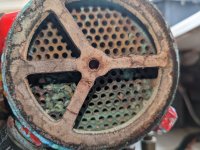
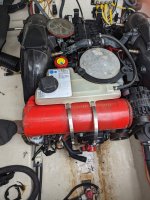
Here are a couple of pics of my heat exchanger for Volvo Penta V8 5.7L

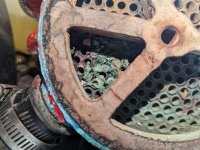
I was going to pull it and have it cleaned and tested. But looks much better than expected. Boat was used in salt water.

Just get a new end gasket and call it a day?

What about the minor amount of green stuff on one smaller section.

I will be using Salt Away when I use the boat this summer. Boat is rack stored.
 

Attachments

  • PXL_20230416_180804172.jpg
    PXL_20230416_180804172.jpg
    1.3 MB · Views: 10
  • PXL_20230416_180755504.jpg
    PXL_20230416_180755504.jpg
    1.3 MB · Views: 9
  • PXL_20230416_182036579.jpg
    PXL_20230416_182036579.jpg
    1.3 MB · Views: 11
I acid washed our heat exchangers and they cleaned up good. Looks like it needs that. But it isn't all that bad. Kind of choked on the lower tubes. I used a bucket and a bilge pump to push the solution through the water pump, heat exchanger, oil coolers, fuel coolers, and intercooler. I forget the name of the product but it was an acid.
By pushing the solution through the whole system it all gets cleaned up. However, make sure to remove the zincs and plug up the holes with brass zinc ends.
 
I found a small barrel rifle cleaning kit just the right size to rod out the tubes. Then a 50% white vinegar in water soak for a few hours.
 
If it was me, I would have them cleaned
 
You can clean them in place lien boatbum suggested using Barnacle buster which is milder than acid. Use a small bilge pump in a bucket to circulate it.
 
You can clean them in place lien boatbum suggested using Barnacle buster which is milder than acid. Use a small bilge pump in a bucket to circulate it.
Does that one need to be cleaned? Looks pretty clean to me.

Will running Salt-Away after each outing clean it?
 
How's your temperature? In my experience, you can get plenty of cooling with blocked/restricted tubes. I don't see the lime buildup I see in mine that requires an acid to dissolve (such as barnacle buster or vinegar). When I zoom in to the picture on the left, It looks like vegetation. Can you vacuum it out? No experience with salt away, but I understand it's ph neutral.
 
Cleaning them out with a wash (acid or etc.) makes a big difference. While under light loads the engine temps may be fine, if you get into warm water expecting performance you may not get it. Other things may happen as well. For example, the raw water pump weep hole may show a drip. This happened on our boat. Once I boiled out the exchangers regularly the raw water pumps were much happier and I could run the engines at full throttle in warm water without any issues.
It was funny when we sold the boat. I boiled out the exchangers prior to the sea trial knowing they were going to run the boat hard. Sure enough we were on the Caloosahatchee River at 20 knots and the engines ran like tops. The mechanic came up to the helm from the bilge and complained because he thought he was going to have an argument to knock the price down. "You boiled these engines out!". I said that's right because I knew you were going to run them hard and it is Summer time. The sales agent looked at me and smiled.
 
I will remove the greenish debris with a brush and a vacuum. Good to go for now. I hope.

I ordered a new 5" gasket (generic for marine heat exchanger) and it's a thin (compared to the old one) and just plain rubber. The old was thicker and more like dense foam rubber. The heat exchanger company said the new gasket they sent me is the proper gasket for a marine heat exchanger. They said they old one could have been an industrial one someone used.

Volvo Penta does not list a part of the gasket by itself. Looks like if the gasket needs replacing you replace the entire heat exchanger for $2100.
 
Back
Top