Merc 140: Sudden RPM Drop, Rough Idle, Engine Shake

myoldboat3

Member
Joined
Apr 6, 2023
RO Number
34841
Messages
26
Hello all,

It's been awhile. I couldn't get my user myoldboat2 to work, so now I registered as myoldboat3. My wife and I have been busy, finally moved onto a lake in the Fox Valley of Wisconsin four years ago. I swear my boat tools and parts are still hiding from me in storage. I spent last summer getting a boat lift in place for the pontoon. It sits in deep water and has been quite a challenge.

The engine ran well last summer, but something happened last fall and I could use your guys' help figuring it out.

GM Engine 140 HP 4-cyl 181 cu.in. s/n 3888148
Mercruiser "Late Model I" Stern Drive s/n 3901959
1974 Harris Flote Bote, 28' pontoon

We were cruising about two miles back to the dock. Like a dope I decided to open it up to full throttle for a while, maybe a mile or more. With maybe 500 yards to go the RPM suddenly dropped from about 3600 to around 2800. (I used to get 4400 rpm at full throttle, but that was with a different prop and a light load.) I throttled it back. When I went to idle near the dock, the idle was very rough and the engine died. I got it restarted and onto the lift, still running rough.

I was more than due for a tune up. I replaced plugs, wires, distributor cap & rotor and fuel filters. No improvement. I have a Pertronix Ignitor electronic conversion kit so no points to replace. I found the Pertronix troubleshooting instructions online so I'll run through those. I'm no good at putting points back in.

I used some carb cleaner. No improvement.

I tried adjusting the Rochester carb idle fuel/air mixture screws. There are two of them at the base of the carb. No improvement. I've owned the boat for decades and one of those screws has always had zero effect. I had the carb rebuilt once many years ago and it's run great until now.

The choke is electric and isn't the problem.

I'm thinking this is my plan when the weather gets a little warmer:

1. Check spark quality
2. Pertronix troubleshooting guide
3. Compression test
4. Check timing & advance
5. Try a different carb

There is a related problem, but I think it's been developing over time. The engine wobbles a lot at idle. I'm adding a video that I took last fall.


-- The video starts with the engine at 140 degF, in neutral at 1500 rpm.
-- At about 7 seconds, I throttled back to 1000 rpm (I went a little lower and came back up, as you can see by the shake).
-- At 15 seconds, I throttled back to the idle detent and the engine settled in at 550 rpm.
-- At 31 seconds I turned the ignition to off.

I would sure love to hear all of your thoughts on this.

Thanks.

Steve
 
The weather has been a roller coaster here. Boat is still covered on the lift. I'll get some youngsters to help uncover it pretty soon.

My list of things to check has gotten much longer. I think the leading candidate for the RPM drop / power loss may be a failed water flapper/shutter that is partially blocking the exhaust. I haven't pulled the elbow in years and I have a few questions.

Does it typically come off easily or need rapping on it with a rubber mallet?

I'll get the Quicksilver gasket. Does it go on dry or with some sealant, like maybe Permatex Ultra Black?

I have the Mercruiser manual for my engine year and s/n. It says "Fill entire area between support brackets and tube with Sealant (C-92-52238). The figure just shows a tube of "Silicone Sealant". I'm guessing this is to avoid rattling noise. Is the C-92-52238 just basic silicone sealant or a special high-temp sealant?

As to the dancing idle, I'm going to check the engine mounts again. I doubt that's it, but I'll do it anyway.

Thanks in advance.

Steve
 
Thanks, HappyKamper, I agree. A compression test is on my list.

This is my current list. Trying to do the non-running items first this Spring.

Last Fall
1. Replaced plugs, wires, distributor cap & rotor and fuel filters
2. Carb cleaner
3. Adjusted Rochester carb idle fuel/air mixture screws

This Spring
4. Crankcase Ventilation - clean hose and flame arrestor
5. Manifold - tighten all cap screws and nuts
6. Check engine oil dipstick for signs of water
7. Check fuel tank for water
8. Check and clean fuel tank vent
9. Check fuel filters
10. Check that rear engine mount elastic nuts are tight (30-40 ft-lb)
11. Check that front mount lower adjusting nut is tight (30-40 ft-lb)
12. Check distributor wire terminals clean and tight
13. Check carb throttle valves fully open when remote full forward
14. Check behavior of electric choke
15. Compression test
16. Pertronix troubleshooting guide
17. Check spark quality
18. Check for intake manifold vacuum leak
19. Check timing (6* BTDC at idle speed 650-700 rpm in gear) & advance
20. Check exhaust flapper
21. Try new carb
 
I ordered the Mercruiser OEM elbow gasket. It said it's graphite. Those silvery gaskets go on dry, right?
 
Yep, should've searched first, sorry.

Post

Post

Post

Post

I'll read what comes with the elbow gasket. I'll clean up the surfaces.

btw, I don't have an Edit button on my posts, just the Report button. I tried searching about this.
 
btw, I don't have an Edit button on my posts, just the Report button.
Are you logged in?

I am reading your post, and have only the "report" button. But for posts that I have made, and when I am logged in ( ie: capable of posting ) I do have the edit button.
-edit, to add-

I can edit only MY posts, of course.
 
Hi Radioactive, yes, I'm logged in and on my own posts I only see Report in the lower left-hand corner.
 
I know of a place you can mail a carb to in NY to have it rebuilt and adjusted properly. Reasonable turn around.

Fuel filter, there could a second one at the carb.

You can use Permatex Ultra Black on the gasket but less is better. Wipe on some and wipe most of it off.
 
Looks like your engine is only running on two cylinders, maybe two and a half. My first thought is you lost a head gasket between two cylinders. Rather than, or in addition too, a compression test you need to run a leak-down test. This test will not only show the leaking cylinder(s) it will also show you where your compression is going. Out the carb? Intake valve. Out the exhaust? Exhaust valve. Out the crankcase vent? Rings or piston. Out an adjacent spark plug hole? Head gasket. Out the cooling system? Cracks or gaskets.
There are other less-likely causes of loosing two cylinders but these are the most common. Forget the routine maintenance until this is done. You may not need to do it depending on what the tests find.
 
Drop something or step on two spark plugs in a row and crack the porcelain?
 
Thanks for the replies. I'm still dealing with issues on this Mercruiser 140. I still haven't found my compression test gauge (somewhere in storage since we moved--everyone should move, you end up with two or three of every tool). I'll just buy another one.

Had a problem with the helm throttle control. A friend took it apart and got it fixed--the threads are questionable but mainly the set screw had loosened.

I replaced the raw water impeller a year ago (June 2022). Temperature was good last summer, now it's running hot. It usually runs at 135 deg or so, now even at low rpm it just slowly creeps up past 160, when it goes over 170 I shut it off to drift for awhile. It's harder to start when hot.

While on the lake, I pulled the raw water feed hose from the thermostat housing and ran the engine for about 20 seconds. With the hose pointed up, at idle I get less than an inch of water shooting up, at 2000 rpm (in neutral) I get less than 3 inches. Isn't this supposed to shoot like 6 inches up even at idle?

That leads me to my next question... the boat sits on a lift next to my dock. For various reasons pulling the boat out of the water is a major pain. I'm wondering if I can backflush down through the raw water feed hose with the sterndrive (including lower unit) in place. Years ago I had an impeller break up, but I very carefully found every piece of rubber--set together like a jigsaw puzzle and got it all. Since then, every impeller removed has been whole. So I'm thinking maybe sand or weed material. If I backflush into the pump, could anything be pushed out the two exhaust ports near the transom, and would pushing anything against the pump likely ruin the impeller? I'm just trying to troubleshoot this before dropping the lower unit, which I think we're going to eventually try from a floating dock setup. Would sure like to avoid that.

I also had to do some carpentry between the dock and the lift before somebody gets killed getting onto the boat. Would sure like to avoid that, too.

I know the next thing on the engine is the compression test. I've never done a leakdown test but I agree that may be needed. Are there some good instructions here on the forum? I didn't find that through searching.

Here's what I've gotten down, with not much improvement:

Last Fall
1. Replaced plugs, wires, distributor cap & rotor and fuel filters - done, no improvement
2. Carb cleaner - done
3. Adjusted Rochester carb idle fuel/air mixture screws -- did this again last month, no improvement in poor running

This Spring
4. Crankcase Ventilation - clean hose and flame arrestor - done
5. Manifold - tighten all cap screws and nuts - done
6. Check engine oil dipstick for signs of water - done, no water in oil
7. Check fuel tank for water - done, no water in fuel tank
8. Check and clean fuel tank vent - done, vent is clear
9. Check fuel filters - I do still need to check the one at the carb, hard to get off. Could that small filter cause all these problems?
10. Check that rear engine mount elastic nuts are tight (30-40 ft-lb) - hard to get to, felt by hand only
11. Check that front mount lower adjusting nut is tight (30-40 ft-lb) - felt by hand only
12. Check distributor wire terminals clean and tight - done
13. Check carb throttle valves fully open when remote full forward
14. Check behavior of electric choke - I have the choke disabled full open, not an issue
15. Compression test - NEXT UP! Then leakdown test, I guess
16. Pertronix troubleshooting guide
17. Check spark quality - I used a spark tester you put between the wire and then the plug, it flashed brightly on each plug. I don't know if this really confirms good spark quality, though. Better to hold the plug a half inch from the block?
18. Check for intake manifold vacuum leak
19. Check timing (6* BTDC at idle speed 650-700 rpm in gear) & advance
20. Check exhaust flapper
21. Try new carb

I also reset the idle speed. It had gotten low. I have it at the spec now, 650 rpm in the water in gear.

Thanks in advance for your thoughts.
 
Compression test is pretty easy. Disconnect ignition, pull all the plugs, put gauge in first cylinder and run starter for 5-10 seconds, basically until gauge does not climb higher. Write down results. Proceed to next cylinder.

You are looking for a compression reading in the ballpark of 150. And almost as important compression that is the same in all cylinders. If bad compression try adding a little oil to cylinder to see if it increases the compression. A little oil will temporarily boost compression due to worn rings.

Bad compression is due to a head gasket or burned valves or worn rings.

Worn rings is never going to cause anything to happen suddenly.

Most likely the head needs to come off. While off you could get the valves redone. Need to make sure the head is not warped. It can be machined if not a perfect surface. Rebuilt head is also an option.
 
Thanks for the replies, ddurand, clshortt and HappyKamper.

I did a compression test on this engine 20 years ago. I'll be doing that next, just need to pick up a new gauge or find my old one. Here are the results from back then:

October 2003
Compression Test
engine warm, throttle full open
cyl -- 1st stroke psi -- final psi
1 -- 110 -- 137
2 -- 110 -- 134
3 -- 102 -- 128
4 -- 103 -- 130

Compression specs:
Merc Pocket Guide -- 140 psi, max variation 20 psi
Clymer -- 132-162 psi, min 100 psi, max variation 20 psi
Mercruiser SB 97-25 -- min 100 psi, min 70% of max

Doesn't mean much today but at least it's a baseline.

I also have to deal with this reduced raw water flow.

1. How high should raw water shoot straight up from t-stat feed hose at idle and at 2000 rpm on the lake?

2. Is it ok to backflush that hose with lower unit in place, to maybe dislodge some sand or weeds?

3. I didn't see leakdown test instructions in the Mercruiser manuals, anyone got a link?

4. Have had a heck of a time getting at the carb fuel filter, could it possibly cause the poor running & reduced full throttle rpm?

5. Are those inline spark testers worth using, or should I just hold the plug a half inch from the block? I'm not keen on holding plugs or wires while cranking.

Thanks.

Steve
 
Making some progress:

OVERHEATING

I backflushed through the raw water hose (pulled off the thermostat housing) for about 15 minutes, then ran the engine on the lift with the sterndrive in the lake. The raw water seemed to shoot higher at 2000 rpm but it might just be my wishful thinking. Still shoots just under an inch straight up at idle.

And then--sometimes I'm an idiot. I replaced the thermostat last fall (Sep 2022) and didn't have the boat out much after that. Then this summer, the overheating problems (when underway, goes right up to 160+, eventually climbs higher). So I pulled the thermostat out today and I'll take the boat out on the lake without the t-stat as a test later this week (weather was nasty yesterday and today). It got dark so I gave up and came up to the house and tested the thermostat on the stove. I ordered a 140 deg thermostat, so it should start to open at 140 +/- 3 deg. It barely moved at 152 deg and really didn't start opening much until 160, then fully open at 168 deg. I couldn't find a stamp on it. I've now ordered an OEM 140 degree Quicksilver 59078 thermostat. Since the temp has still been climbing up near 185 underway (when I shut it down), the thermostat is only part of the problem, but we'll see when we get it out on the water. I'm old enough to know that you should always test a thermostat before installing it. Ugh.

ROUGH RUNNING

I sprayed some carb cleaner around the base of the carb and on one side got an RPM drop, so a vacuum leak. I did that last fall and didn't find it. I tightened up the carb bolts (which seemed pretty tight) and the leak seems to be gone. I'll probably have to readjust the carb because apparently my adjustments were done with a vacuum leak. We'll see once on the water.

New compression test gauge (still can't find my old one) and a leakdown test kit arrive in the next few days.

Stay tuned.
 
Your overheating is probably related to your lack of power.
Often when you have a bad head gasket and there are water flow issues, you will see water in the oil...not always.
Water can be escaping out your exhaust prematurely, or an exhaust valve is stuck closed, who knows.

It's been a couple of days, hopefully the compression kit will arrive and you can get those numbers.
I'd put the overheating on the back burner for now.

Fuel+Spark+Compression = POWER
 
with regards to not being able to edit posts - that's likely related to your status as a new member. I believe in our spam control settings, the default is not to let people edit posts until they reach some number - as spammers found they could post something that looked legit, then edit the post to sell their off brand viagra...

your myoldboat2 account probably has an old email address. that can be fixed, if you would like. but it can't be the same email address you used for myoldboat3.
 
with regards to not being able to edit posts - that's likely related to your status as a new member. I believe in our spam control settings, the default is not to let people edit posts until they reach some number - as spammers found they could post something that looked legit, then edit the post to sell their off brand viagra...

your myoldboat2 account probably has an old email address. that can be fixed, if you would like. but it can't be the same email address you used for myoldboat3.
I can buy viagra here?
 
Thank you for the info, alk. I'll just try to be careful to avoid needing to edit.

Thanks for the input, Walshie.

Update:

OVERHEATING

The new thermostat should arrive today, but I tested the boat yesterday with the defective thermostat removed. I could cruise around at 1500 rpm and the temperature stayed at 132 degF. At 2500 rpm, the temp slowly climbed and settled at 157 degF. I couldn't test higher rpm because at about 2700 rpm, the engine sort of coughs and drops down to about 2000 rpm (see Rough Running below).

I checked the raw water pump flow rate from the feed hose disconnected from the thermostat housing. Here are the results compared to my estimates in my Raw Water Pump Minimum Flow Rate GPM post:

1000 rpm: estimated minimum requirement 2 to 3 gpm, I got 1.6 gpm
2000 rpm: estimated minimum requirement 4 to 5 gpm, I got 2.1 gpm

So I'll need to drop the lower unit eventually, but I have bigger fish to fry for now...

ROUGH RUNNING

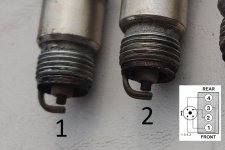
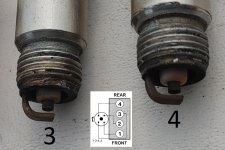
Here are my plugs.

Pontoon Spark Plugs 1 2 2023-06-28.jpg

Pontoon Spark Plugs 3 4 2023-06-28.jpg

Compression test
Engine warm, 130 degF

Cyl 1 ... 135 psi
Cyl 2 ... 0 psi
Cyl 3 ... 0 psi
Cyl 4 ... 95 psi

We went back and forth between all cylinders multiple times to confirm the readings, using first the screw-in fitting and then the rubber push seal, and yes, cylinders 2 and 3 are really zero.

No water in the engine oil.

Here is the engine running after the compression test. I started it, throttled up to 1500 rpm, then to 2000 rpm, then quickly pulled it back to idle. All in neutral. Boat on lift with sterndrive in lake. Will it run like this on two cylinders?


I guess pulling the head is in my future. I think that'll be a mid-summer or fall project.

Steve
 
Back
Top