Trawler vs. Sedan/Convertible

folieadeux

Member
exMember
Joined
Jul 9, 2007
RO Number
27326
Messages
760
As the Admiral and I plan our next boat purchase we have decided that comfort, space and fuel economy are our top priorities. We are trying to decide if we are ready to move into a 40ish foot trawler style rig and be content to putter at 8 knots or if a 40ish sedan/convertible will be a better fit for us. I understand the mechanical benefits that a trawler offers but the plush comfort levels of the sedan/convertibles are very appealing.

My questions is if I purchase a twin diesel powered 40ish foot sedan/convertible, what are the disadvantages of operating a sedan/convertible at trawler speed? It seems to make a lot of sense to be able to have the extra power of a sedan/convertible when you want or need the power. The fuel consumption does not appear to be drastically different between the two styles when both are operated at the trawler speed of 6-10 knots.

I realize that the hulls are designed differently whereby the sedan can rise onto plane but is it harmful if you operate a sedan for long periods of time without being on plane?

Any other advantages or disadvantages you would like to share would be appreciated.
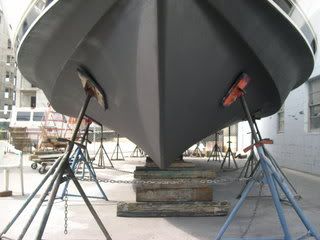
 
My Meridian Sedan Bridge is actually a Semi Displacement Hull. It's not a tru planing hull. I think most Sedans in the size range you are talking about don't really come up on plane. They do rise somewhat but I don't think it is necessarily a bad thing to run them at slower speeds. I get the best MPG at around 4000 RPM's so that's what I cruise at. I can't see doing any harm running at slower speeds most of the time. I wouldn't run only at idle speed. I think it's good to upen up to over 3000 RPM once in a while to avoid carbon build up.

I'm talking about gas engines and you are probably talking about diesels so it's a different story. My understanding is that diesel engines have more consistent power output across a wider RPM range. I believe that diesel engines can run all day at any RPM.
 
No disadvantages though you will be happier with a boat that tracks well and doesent throw much wake. My friends have 42' searay aft cabin boats with prop pockets IMO they are a bit faster at top end but at lower speeds they drag a lot more and make a lot more wake than my 44' Carver ACMY with twin 450HP diesels and a semi keel. I think my hull would be called semi planing. You are on the right track about fuel use I get between about 3NMpg at 7kts and 2 at 8.5 which is my favorite speed. I have never gone far enough to accurately measure single engine fuel use.
BottomJob2006-10-18133917.jpg

BottomJob2006-10-18133910.jpg

IMG_5526.jpg
 
I have to ask are you putting the cart before the horse here. I understand the fuel concern (God do I understand!), however what about time? Hypothetically, if your current or former boat could cruise at 20 knots and all your favorite spots are say an hour away are you willing to buy a trawler that travels 5 knots and take 4 hours to cover the same distance? I realize the trawler is smaller inside than a sedan, but there is a lot to be said for the walkways stern to bow that are actually useable.

Grand Banks builds gorgeous trawlers.
 
The other consideration is getting engines to operate in the correct temperature range. That can be harder to do in a sedan/converible at hull speeds. Nothing planing on occasion can't can't solve but unlike trawlers, these engines will be operating well below their peak efficiencies.

... the inability to go above 8-10 knots would also be a problem for me. Although I too understand the fuel situation.
 
The hull on my Sedan has a keel very much like Bruce’s Carver and the boat tracks very well at low speeds
With twin 660HP Cats I get approximately 3 MPG at 7knts and 1.9MPG at 8knots
It’s downhill from there with .65-.70MPG at cruise- 22-26knots
So I can run at “trawler’ speeds with low fuel consumption-unfortunately it seems that I don’t do it often enough- maybe this year I will slow down and save some money – maybe not [:-eyebrows]
 
probably only when you are out of the channel Andy. :D
 
Originally posted by KiDa

I have to ask are you putting the cart before the horse here. I understand the fuel concern (God do I understand!), however what about time? Hypothetically, if your current or former boat could cruise at 20 knots and all your favorite spots are say an hour away are you willing to buy a trawler that travels 5 knots and take 4 hours to cover the same distance? I realize the trawler is smaller inside than a sedan, but there is a lot to be said for the walkways stern to bow that are actually useable.

David, I am not sure I fully understand your response. I do understand your concern about time but I think once you make a decision to move into a trawler or sedan, you have made the decision to take a little longer to get somewhere (unless you want to break the bank at the fuel dock). Small boats will just about always run faster and cheaper than cruisers but comfort is high on our priority list.

Using your example above, if I could cruise at 20 knots and burn 30 gallons of fuel at $4, my trip cost $120. If I go at trawler speed and burn 12 gallons at $4, my trip cost $48. I guess the value of the 3 hours of time has a different meaning for each boater.

It would make things a lot easier if we could get back to $1 per gallon for gas.
 
I forgot to add it'll cruise nicely at 18 kts if the weather or the skipper need it.
 
There are loads of trawler builders out there. JMO but Grand Banks is overrated & riding on a name, which is not to say that they are not nice boats. Trawlers can be very roomy boats. There are 3 basic configurations, tri cabin (the traditional look), Sedan, & sundeck. The sundeck style has the master cabin under the aft sundeck & typically it is huge. Most of the 38' plus trawlers have 2 diesels. Finding one with a pair of 200hp diesels is not difficult & it will comfortably cruise at 10kts which is not a bad speed.

A similar length sedan/convertable will not have near the human space as the trawler. It will not have near the necessities for cruising like fresh water capacity as a trawler. With its larger engines it will cost far more than the trawler to operate, unless, of course, it is operated at trawler speeds.
 
I spent a week with four other women on a 44' trawler in the Washington San Juan's about three years ago. It had a queen sized aft cabin and two forward berths. She cruised at 9 knts with twin diesels. Plenty of room, lots of comforts, and we went to a different anchorage or marina for each night. Our schedule allowed for about 3 hrs cruise time each day. That left us with plenty of time for exploring, crabbing, etc. It was a great time!
 
G

Most trawlers are trawlers in name only. They are just underpowered semi planning boats such as the GBs.
 
I think you as a couple need to spend a good deal time on a number of boats. Bruce is right, "Trawler" has become to mean a style of recreational boat. The hull form is not that of a real trawler, ie, a big round full displacement. Krogen, Nordhavn and a few others do make boats with that hull form. I have found most all "Trawlers" I have been on to be more livable than sedans. But there are so many boats called so many things that are different from each other, generalized nomenclature is almost irrelevant. Ergonomics is a very personal thing, and vary whether you are under way, close quarter maneuvering, on the hook, working in the engine room, or at the dock (or any combination of the above!) A lot of people buy a boat based on a quick walk through without considering all these factors.

George

Averaging 8.5 knots on a Hatteras 56MY
 
Neal,

caltexfla articulated far better than I the point I was trying to get across.

When I think sedan, I think a Carver, Hatt aft cabin or the like. Both easily capable of both trawler speeds and cruising speeds. At hull speed, they are efficient but are they as effecient as a trawler? I do not know. I do not have the education to figure that one out.

When I think trawler, I think Grand Banks and similar. The last time I looked at them was over 20 years ago and they were beautiful yachts incapable of anything greater than hull speed. I did not realize GB is out of the true trawler business. My bad.

Before I bought Saint Max, I discussed the fuel consumption of an express cruiser vs a sedan or trawler with a friend who has a 4588 Bayliner. He told me at hull speed it takes him about 4 hours to get to one of our club's annual trip destinations. Based on similar boats with similar configurations as Saint Max it will take me 2 hours to make the same trip. When all is said and done, my fuel burn will be roughly 25% greater than his for that trip. Granted, it's apples and oranges on the size aspect of the two boats. The point he was trying to make was that if time is important to someone and you don't want a pocket rocket you are going to pay for it, but not as much as one would think. As an employee vs. an employer, my free time is free time has certain parameters and I needed to take that into consideration. He went on to say that having known me for 16 years he knew I was not at the point in my life that would sit well with taking a 4 hour trip that could be done in two. In other words, I had not slowed down to smell the roses.
 
David:
I doubt your fuel use on plane, in NMPG will only 25% greater than off. I suspect it will be more like 4x greater on plane than at hull speed.
 
George is correct. A trawler would have round chines and raised bottom at the stern for slippery movment and smoother rolling. Those pretty Grand banks are nice boats but trawler in name only.
 
quote:

Originally posted by pdecat

David:
I doubt your fuel use on plane, in NMPG will only 25% greater than off. I suspect it will be more like 4x greater on plane than at hull speed.


Apparently I did not make myself clear...again! TGIF. In that we both boated together, my comparison was meant to be that MY consumption in total fuel burned would only be about 25% greater than HIS consumption in total fuel burned for the same trip. Cost and type of fuel D v. G were not taken into consideration. Simply gross numbers of gallons burned.
 
I think one of the big factors to consider is where do you typically take the boat, how much distance is involved and are you ready to add x number of hours to the trip or will you end up not using the boat as much because you can't get to your destinations in a reasonable amount of time?
I've seen it happen with friends who moved to a slower boat where now it takes 2-3 times longer to get places so unless they can block off a couple days at least they don't bother going out. If you're used to going long distances it could be an issue, if everywhere you go is within a few miles then it's not as much of a factor.

As far as running the higher speed boat slow, I know my diesels don't come up to temperature if I stay around 8 knots. When trolling while fishing I'll run the engines slow for hours but then have a long run home to warm them back up. If you're running slow all the time I'm not sure how good that is for the engines, you'd probably want to speed them up for a bit each trip to brings things up to temperature. In my experience also it's very hard not to hit the throttles when you know the power is there... And as someone pointed out bigger engines are more expensive to maintain so if you don't plan to use the speed it can be an unneccessary expense. You need to think about how you'll really use the boat and also look at what's out there as far as different options.

John
 
Neal,

My understanding is that it is not good to run diesels at low speeds for any great length of time. I was told by numerous people "diesels like to be run and run hard". I guees other will chime in about that statement, since I never owned a diesel, I have no first hand experience.
I mentioned the above because if it is true, I thought it might be something you need to know.

Walter
 
Back
Top