Winterizing Diesels

Sandy K.

Member
exMember
Joined
Mar 15, 2001
RO Number
3775
Messages
406
Engines - 3126 Caterpillars
Genny - 7.6 KW Diesel Westerbeke

Was discussing winterizing the engines with one of my dock buddies and I mentioned that I really need a yard that can do the work for me, as I've never dealt with the engines before.

He commented that if I have sea strainers inside the engine room then it's as simple as closing the seacocks, opening the strainers and pouring pink in,then start the engines and keep adding pink until it comes out the exhaust pipes. Then shutdown the engines.

Is it really THAT simple?? I'm assuming this gets done once we haul her. Would it also be the same for the diesel generator?

I've winterized everything else by myself in the past, it's just the engines ($$$) that I am most concerned with.

TIA,
 
Yes, it's that simple, same for the genset.

Change the oil first before you fill it with pink.

I over do it and run 10 gallons of the pink per motor, the genset I run 3 gallons thru to be sure.

If someone is standing outside of your boat and sees heavy pink coming out of the exhaust then you are done.

Simple.
 
If you don't mind, let's "discuss" technique.

I'm wondering about the required speed of the fill. Do you pour the pink directly from the 1-gallon containers, or do first fill a bucket? Sounds like you need at least 2 people and maybe a third (to watch the exhaust outflow and scream up tot he bridge to shutdown).

Also, I assume you shut down the engines once pink STARTS to come out of the exhaust - with the idea that you leave it in the engine over the winter. Correct?

I also assume you've got to have a bucket or something else to catch the "exhausted pink" so as meet local environmental rules??

Thanks,
 
Ok,

My technique is to remove the hose from the seacock and put that hose into a 5 gallon pail filled with pink. Start the motor, it takes like 10 seconds to suck the 5 gallons in. Stop the motor. Fill the pail again. Start and stop again. I think you will be ok pouring the gallon into the sea strainer as well but be prepared with all of you gallons at the ready.

I have engine controls in my engine room so it's a one man job for me.

I like to have the pink flow a bite, the first sign of pink will be diluted with sea water so I like to let it come out real solid pink, that why I use 10 gallons. The entire raw water circuit is less than 10 gallons.

Yes you leave it in the cooling system over the winter. There really isn't any pink in the motor, just in the coolers, heat exchanger, hoses, mufflers, etc...the motor is filled with anti-freeze.

The pink can go on the ground, it's ok for the environment. Green anti-freeze is not.

PM me if you have any other questions.

Jonathan
 
I'm jumping in here.

Change oil in Gen & Mains then run pink thru raw water systems and your done ? That's it ?
 
Sandy:

I have the same motors as you in an express cruiser.

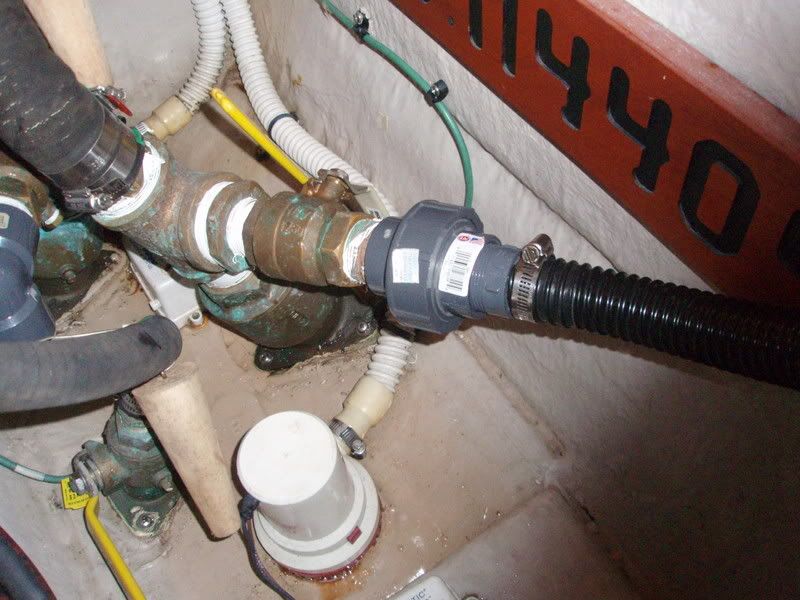
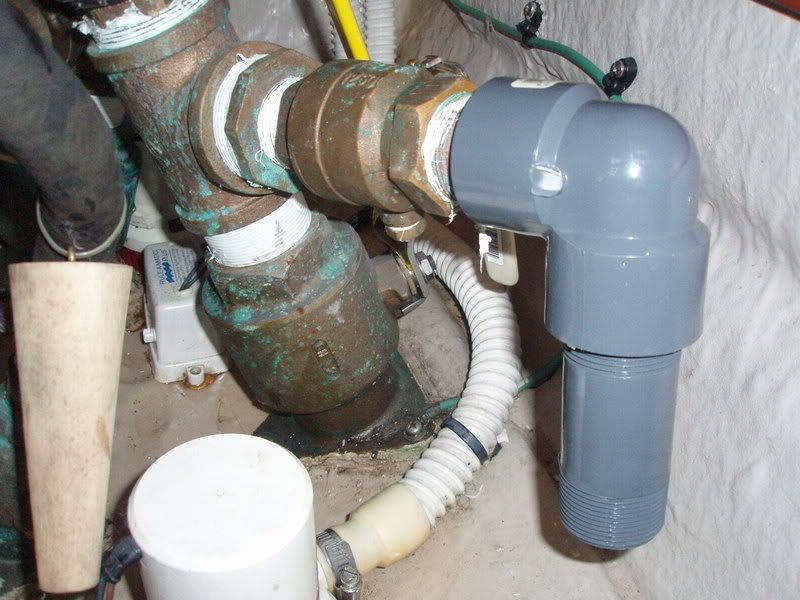
I added a set of flush/crash valves to my seacoks .....

PB170667.jpg


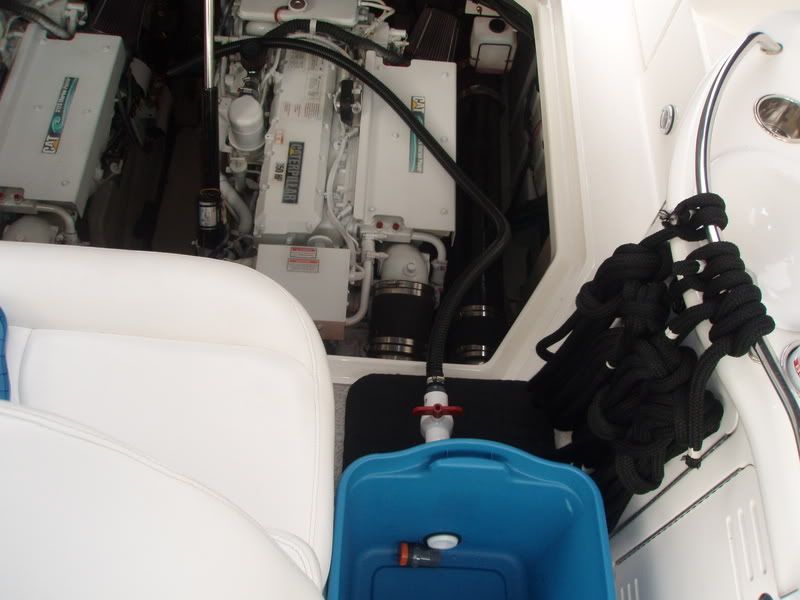
when it's time to winterize, I remove the elbow/extension, and 'couple' a long hose...

PB170668.jpg


to a large bucket topside....

PB170670.jpg


I then close the seacock, and fill the bucket with water and let a fresh water hose run in the bucket for 'a while' to flush the motors. When the flushing is complete, I shut off the fresh water hose supply and let the motor drain the bucket. Just as the bucket is about empty, I shut the motor down. I then fill the bucket with ~8-9 gallons of pink antifreeze and repeat the process.

Also, and IMHO, very important, before I even start the 'final' winterization of the motor, I fill the fuel tanks and treat the fuel with a full dosage of Diesel Kleen winter blend and good diesel fuel stabilizer.

I also take engine oil, trans oil and Engine Antifreeze samples and send them off to CAT for analysis. Then I change: the engine oil (all 26.5 quarts) with Rotella T-30, the oil filter, the Primary Racor Fuel filter (30 Micron)and the secondary on engine CAT fuel filter.
 
quote:

Originally posted by giolic

I'm jumping in here.

Change oil in Gen & Mains then run pink thru raw water systems and your done ? That's it ?


Yup!
Just as Jonathan said
you may want to add some Biocide stuff to the tanks
 
oopss!...I forgot to add that I also change the engine zincs ....3 in the heat exchangers, 1 in the exhaust elbow, 2 in the trans oil cooler and 5 in the aftercooler.
 
quote:

Originally posted by dominic

oopss!...I forgot to add that I also change the engine zincs ....3 in the heat exchangers, 1 in the exhaust elbow, 2 in the trans oil cooler and 5 in the aftercooler.


agreed- I do mine in the spring

Dominic
Nice setup, do you have strainers?
 
Nice setup Dominic, great photo essay too!

I do the zincs in the fall since I do in water storage.
 
quote:

Originally posted by abalmuth

.......
Dominic
Nice setup, do you have strainers?


Thanks.

Yes, I have strainers. They are further 'up' in the raw water circuit, ahead of the sea water pump. I keep them clean throughout the season, so I don't necessarily make cleaning them out a part of my winterization routine unless it's been a while since they were last cleaned. But it's a good point to check them before the layover.

I bought my boat used. The previous owner is also a member on this board. He installed the original crash vavles. I modified the setup to allow for easy flushing and winterization in addition to maintaining the ability to quickly deploy as crash valves should the need (hopefully never) arise.
 
Great info here guys - Thank uyou.

When the sea strainers were installed the mechanics also added valves that would enable me to draw water out of the engine room using the engines. Similar set-up to what Dominic has done. Looks like I could possible use the valves to take-up the pink.

Thanks again.
 
Yes you can, one option is to stick a bucket under the pick-ups, fill and go, easier to pour into/fill the larger bucket than to fill thru the strainer IMHO.

You might have to cut a notch out of one side of the bucket to get it to sit nicely.

Or extend the pickup like Dominic did.

I like that setup he has.
 
We have seacocks drilled and taped into the top of our strainers. Both eng. Gen. and AC. They except a hose fitting, that we also plumbed to a bucket and add our antif that way. We also use the same set-up to blow comp. air back through the strainers to the thru hulls to eliminate any water, since we also stay in over winter. I do use 100 anti freeze, cause it is a whole lot cheaper than replacing an engine. Probably overkill, since I also use a boatsafe heater, but ya just never know ?
 
quote:

Originally posted by Dusty Rhoads

I do use 100 anti freeze, cause it is a whole lot cheaper than replacing an engine. Probably overkill, since I also use a boatsafe heater, but ya just never know ?


I hear you Dusty
I also use block heaters, My engine were replaced once already(not freezing related),
I do everything I can to protect them since I would not want to go threw them being pulled and the cost is not for the light of hart
 
diesels pump an amazing volume of water so I suggest it is advisable to have a system with sufficient volume available without interruption to avoid burning the impellers.
 
Bruce....you are right on target...

I have a smalller 4 gallon bucket that I used, in a similar way as above, on my big block gas motors for years. I connected the hose and bucket to a modified cap on the top of the sea strainer. Never had a problem. I still use this smaller 'bucket' and sea strainer setup to pump antifreeze through my genie and air condtioners. But when I fill up the 'big' bucket with ~9 gallons of antifreeze, the diesel suck that bucket dry in like 20-30 seconds...it's amazing to see.
 
I own a 405 Crusiers Express motor Yacht with a Hard Top. Is it necessary to SHrink Wrap the boat for the Winter? I was thinking of winetrizin it in the water this year.
 
Back
Top