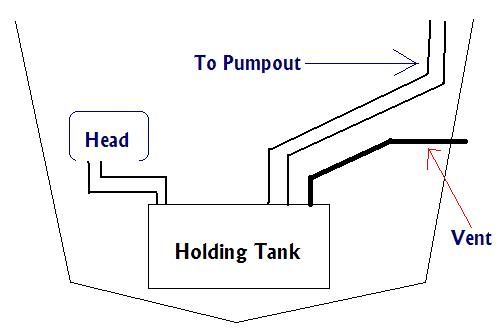
This issue has been beat to death, both here and other places, for years and years...
1. If the tank is well vented, and I mean WELL vented, not a single 5/8" ID vent line that most builders provide. IF it is well-vented, no additives, filters, etc. are necessary. A holding tank is basically a variation of a septic system that many homes have, out in rural areas. When they're working right, there is no smell from them. But when they aren't working right, your neighbors aren't your friends any longer...
2. What constitutes a well vented tank? First, TWO vent lines, exiting on opposing sides of the hull, preferably well forward to give you cross ventilation of the tank. Just like opening windows on opposite sides of a room will improve the flow of air and ventilate the room. Next, the larger the diameter of the hose and fittings, the better. Absolutely no smaller than 3/4" ID should be used, and larger if at all possible (note that most boat builders use 5/8" ID vent hoses, the same as are used for water tank vents and fuel tank vents). Further, they often use the same through-hull fittings that are used for fuel tank venting, with a screen installed as a flash suppressor. This is a cost-cutting measure, to standardize all the hose and fittings sizes and reduce their inventory requirements. The screen is required for fuel tanks, but not for holding tanks or water tanks. Mud daubers and other insects love to build their nests in these screens (maybe they like the smell, I don't know) which plugs them up. So if your vent through-hull fitting has a screen in it, take an ice pick and remove the screen (holding tank vent only) - you don't need it, and it can cause more problems than it solves.
Ideally, two 1 1/2" vent lines would be the perfect system, but this is rarely possible.
Air has to be able to exit the tank as it fills, and also has to be able to come into the tank as it is pumped out. The more air coming into the tank, the better. If the vent line is plugged up, air can't exit as the tank fills and the tank then becomes pressurized. This makes it harder for the toilet to flush, and often results in dirty water backing up into the toilet bowl. The pressure tries to relieve itself, and it takes the path of least resistance - through the joker valve and back into the toilet. Also, if the vent line is plugged up, you won't be able to pump out the holding tank. Air must be able to come into the tank as it is being pumped out. If it can't, the tank won't empty. There have been cases where the tank cracked or actually imploded, due to vacuum being created inside the tank from the pumpout pump.
3. Other than being able to replace the solids and liquids being pumped out of the tank, why do you need air? There are two types of bacteria in human waste: aerobic and anaerobic. Aerobic bacteria thrive in an oxygen-rich environment, and do not stink! Anaerobic bacteria, on the other hand, prefer an environment with very low oxygen, and they do stink! So, if you have a tank that isn't adequately vented, the anaerobic bacteria take over and the contents of the tank and the fumes coming out the vent line stink like crazy. That's where the smell comes from when you flush your toilet, and a blast of foul odor comes out the vent fittting on the side of the hull. The incoming "deposit" from the toilet forces some air out the vent line. So the object is to get plenty of air into the tank to increase the aerobic bacteria and lower the associated odor.
4. When a tank isn't sufficiently ventilated, the air being forced out of the tank as the toilet is flushed, stinks! This is often where the vent line filter comes into play - as a last resort. They vent lines are too few or too small, and NOTHING seems to be able to kill the smell coming out of the vent outlet on the side of the boat. A vent line filter usually WILL work in this situation.
I personally don't like them, because they're basically a compromise, plus they're expensive, they have a limited lifespan, and if you overfill the tank and the inside of the filter gets wet, they're toast and must be replaced. I much prefer to see the tank vented properly instead.
5. Raritan KO requires an oxygen-rich environment in order to work. It creates more and more aerobic bacteria, which offset the anaerobic bacteria, and the tank doesn't stink. If the tank isn't vented properly, KO won't work, because not enough oxygen is coming into the tank. Note that the head (and tank) shouldn't be used for urine only - the tank must also have #2 in it, to feed the aerobic bacteria. If there's no #2 in the tank, there's no food for the bacteria and they starve and die off, being replaced by stinky anaerobic bacteria. A lot of people complain that their tank is well-vented, but that the KO doesn't work, they get a very strong urine smell out the vent. That's right, urine is sterile, and provides no nourishment for the aerobic bacteria. Plus, it's slightly acidic, and tends to accelerate their rate of dying off. So you can't have only #1 in the tank for KO to work; you gotta have both.
Odorlos on the other hand, works in some situations where KO won't work, as it generates a certain amount of oxygen from the nitrates in the sewage - again, increasing the aerobic bacteria in the tank. But again, you hafta have #2 in the tank; not #1 only.
Most other holding tank products contain harsh chemicals and perfumes that mask the odor, rather than eliminating it. Some of them even contain formaldehyde compounds (somethimes called Formalin - to trick you into thinking it doesn't have formaldehyde in it). Formaldehyde is a suspected carcinogen; certain agencies actually report that it IS a carcinogen! Not something you want to add to the water that you're swimming in.
6. The Groco "Sweet Tank" system has a perforated pipe grid in the bottom of the tank and an external air pump, pumping air into the tank all the time. Reports I've heard are that it works very well, and might be worth considering when replacing a tank or when purchasing a new boat. I don't think I'd want to try to add it to an existing tank that's already been in use. Now, the air pumps used for this application are a pretty high volume air pump; you can't use a pump that is intended to aerate the aquarium in the corner of your living room or office. They don't put out enough air to make any real difference.
Nuff said, all this discussion has made me hungry - gonna go to lunch!