Strong odor when you flush

TimHenn

Member
Member
Joined
Jan 1, 2000
RO Number
126
Messages
346
This problem has been bugging me for a while. Whenever someone flushes the toilet a short but potent odor is noticeable in the cockpit starboard side of the boat (as best I can tell). The holding tank is mid-ship, starboard side.

I've replaced the hose from the head to the main valve in the bilge. The remaining hose is likely old but I have no other reason to believe its failing. It doesn't leak. The holding tank is plastic and seems intact.

How can I diagnose this (it won't be fun no matter the approach)? Is it easier to replace the hose and tank?

Thanks for the help,
Tim
 
Do you have a filter on the vent hose on your boat? I would highly recommend if you do you replace the filter if you don't install one right away. How old is the Poly (plastic) holding tank and is it at least 3/8ths thick? I doubt the tank is bad or it is permiated the hose maybe a different story.
Bill
 
It's the vent line, working like it should, venting, if you have a filter on it then check the line.
 
Vent line? I'm not sure what that is, but, I will look for it. The plastic is likely original so 21 years old. 3/8ths thick, don't know but it seems pretty sturdy so it could be that thick.

Where would a vent line typically vent to...in other words, what am I looking for? If the line and filter exist I've never replaced either one of them, doh!
 
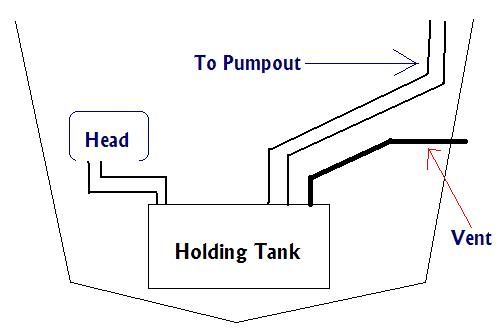
More than likely the vent line will be at the top of the tank and be 3/4" to 1" hose. If it's not on the top it will be the highest and smallest line leaving the tank and it should exit through a through hull usually higher than most of you other thru hulls. Take a good look at the tank it will be obvious. Also if your lines are 21 years old they will need to be replaced as for the tank I am not sure. I would try treating the tank after all the hoses are replaced. The easiest way to see if the hoses are permiated is to wrap a warm damp rag around each hose for 15 minutes and then smell it. You will know if they need replacing because the rag will smell. 21 years that has to be a record for hoses if you never replaced them.
Bill
 
MSD_Simplified.jpg
 
If your waste lines are 21 years old, they are shot and need to be replaced.
 
The hose from the tank to the macerator and the hose to the pumpout fitting are likely the original hoses -- I've never replaced them. The house from the head to main valve just before the tank was replaced 2-3 years ago.

I will look for the vent line. I've never noticed a line off the tank but its likely a fitting like the gas tank vents and those have clogged before. I will take a look next time I can get to the boat which is never soon enough. Love the idea of the rag before I rip out more hose but your all correct its time to replace anything that hasn't been replaced with regard to hose.

Thanks for the help,
Tim
 
quote:

Originally posted by TimHenn

The hose from the tank to the macerator and the hose to the pumpout fitting are likely the original hoses -- I've never replaced them. The house from the head to main valve just before the tank was replaced 2-3 years ago.

I will look for the vent line. I've never noticed a line off the tank but its likely a fitting like the gas tank vents and those have clogged before. I will take a look next time I can get to the boat which is never soon enough. Love the idea of the rag before I rip out more hose but your all correct its time to replace anything that hasn't been replaced with regard to hose.

Thanks for the help,
Tim


The hoses aren't the cause of your odor. Neither is the tank. Permeated hoses or tank will cause odor all the time, not just when the head is flushed.

It's not a clogged vent or filter either. If the vent fitting or filter is clogged, you cannot flush the head because air pressure will build up in the tank when you attempt to flush. Nor can you pump the tank out.

Some people believe a vent line filter causes more problems than it solves because it reduces the air flow in the vent line. I am one of those people. You can eliminate the filter with a piece of hose and fittings or just install a new one piece vent hose.

What you are smelling is air being expelled from the holding tank as the head contents are being pumped into the tank. The best thing you can do is to try and eliminate or reduce the odor by using a holding tank treatment product.

There are two options; A chemical treatment that tries to kill any organisms in the sewage and mask the odor with a perfume, and a "natural" biological product that tries to "digest" the sewage. "Odorlos" is one such product and that's what I've been using for several years. It's important to avoid adding anything else when using these natural products as chemicals will kill the bacteria or enzimes that these products contain.
 
quote:

Originally posted by HOGAN

If your waste lines are 21 years old, they are shot and need to be replaced.


if the smell is outside after a flush, hoses are completly irrelevant!

the only cause for outside smell is the tank vent, nothing else.

tow options... use treatments to reduce the smell, odorloss for instance, or add / replace teh charcoal filter on the vent line.

the vent line goes from the top of the tank to a small vent fitting outside, on the hull or cabin side. If the smell is worst on the starboard side of the cockpit, then chances are your vent is on the stbd side, mid ship.

Charcoal filters are made by sealand, about $80 a piece, last 1 to 2 years. If using one, be VERY careful not to let tank overfill as when wet, they clog. this will result in your tank getting pressurized after flushes and collapse when pumping out.

i'd try treatment first, then if that doens't work, put a filter on the line.
 
Somebody a long time ago had a really good post on how to replace the charcoal in filters with pictures brand names everything.
 
I found the vent line. I don't think there is any kind of filter inline. I do use treatment (chemicals) but have never tried odorloss. Maybe thats next. If the vent line is supposed to vent some or most of the smell when flushing then the outside end could use a cleaning; there is salt build-up on the end reducing the air flow...maybe part of the problem. Still need to try the wet rag thing just to confirm the hoses are not an issue.

I guess its worth asking -- if everything is working properly should anyone experience a strong smell in the cockpit (outside)? We also smell it inside the cabin so something isn't working right. Where do I purchase Odorloss?
 
I used K. O, which BoatFix handles, but I do not think I am willing to recommend in your case. K O uses an active bacterial colony and it requires very good ventilation ( and it works wonderfully as well as inexpensively ). But if your H/T does not have very good ( or better ) ventilation, then the K O itself will create an odor issue... But used correctly, it, imho, is the best way to handle H/T sanitation. ( Distributed by Raritan Engineering )

Odorlos ( which BoatFix might handle, but I could not find ) can be bought many places, including sports stores, big box stores, and RV stores. It is also likely available in the brick and mortar marine stores. It is a fairly common product. Odorlos uses the enzymes only ( no live colony ) and ( I think ) also has a chemical oxidizer, which aids the breakdown process. This is why it is usable in less well ventilated systems. I know many users who are happy with it. Personally, I find it to be more expensive than K. O.... :)

In any event, if using Odorlos ( or a well-designed K O system ) the small quantity of air discharged by flushing the head will range from hardly noticeable to noticeable, but not offensive.

IMHO, the formaldehyde ( embalming fluid ) methods ( the "blue stuff" ) stinks under all conditions, and stinks greatly fairly often. Also, the chemistry is just plain toxic, and not very environmentally friendly. There have been ( unconfirmed by me ) reports that some city sanitation systems will not allow it to be pumped out because it "kills" their treatment systems.
 
One thing that is often overlooked, because "it is yucky", is that a Marine Sanitation Device is closer to a greenhouse than it is a containment vessel. If you view it correctly ( as a greenhouse ) it becomes much easier to understand. And like most things, it is usually best to let a thing do what it does naturally rather than try to force it into something it is not. The active and enzyme systems help the natural process and help avoid the odor issue. The "kill everything in the tank" methods are, well, overkill and not all that effective ( biologically sanitary, but chemically broad-spectrum toxic )

From an odor standpoint, "soft hose", which is common on boats, is a less than optimum product for the handling of decomposing organic matter ( so is HDPE, what your H/T is likely made of... ). The biggest issue is that the "lighter fractions", aka: odors, can move osmotically through the moderate density plastics ( hoses; tanks ). If you find that it is time to replace the hoses ( see the "rag test" described above ), you might want to re-think the system a bit. You -can- use standard household PVC sanitation pipe, with "rubber" fittings. The higher density PVC does not suffer from permeation, and is quite a bit less expensive than "odor resistant" marine sanitation hose.

---

As usual, I have likely over-answered your question. My apologies if I have done so... ;)
 
quote:

Originally posted by PascalG

quote:

Originally posted by HOGAN

If your waste lines are 21 years old, they are shot and need to be replaced.


if the smell is outside after a flush, hoses are completly irrelevant!


Why do you insist on posting incorrect information as if it were the bible truth? You seem to know a bit about boating. Why would you rule something out in such a fashion, when you should know the life span of waste hoses. The first thing that he should check are the hoses.

If the vent filter (if he even had one) was clogged, it would stop the flow of air and gases out of the boat.

The OP has added that the odor is also in the cabin - how does that affect your pronouncement.

Waste hoses have a limited life span, especially the older ones. They don't have to be leaking to be letting the odor out.

The purpose of this site is to give as much information as possible, by your summarily stating that there is no way it could be the hoses, you do a disservice to anyone reading this thread.
 
quote:

Originally posted by HOGAN

quote:

Originally posted by PascalG

quote:

Originally posted by HOGAN

If your waste lines are 21 years old, they are shot and need to be replaced.


if the smell is outside after a flush, hoses are completly irrelevant!


Why do you insist on posting incorrect information as if it were the bible truth? You seem to know a bit about boating. Why would you rule something out in such a fashion, when you should know the life span of waste hoses. The first thing that he should check are the hoses.

If the vent filter (if he even had one) was clogged, it would stop the flow of air and gases out of the boat.

The OP has added that the odor is also in the cabin - how does that affect your pronouncement.

Waste hoses have a limited life span, especially the older ones. They don't have to be leaking to be letting the odor out.

The purpose of this site is to give as much information as possible, by your summarily stating that there is no way it could be the hoses, you do a disservice to anyone reading this thread.


PascalG posted pretty much the same thing I posted and I believe he is correct. The OP originally stated that the odor was noticed only when the head was flushed and from the starboard side of the cockpit. This statement would eliminate permeated hoses as the source of the problem. After my post and PascalG's, he posted that the odor was noticable inside the cabin as well. He did not specify if it was only when the head was flushed or all the time.

I won't dispute your contention that 21 year old sanitation hoses are well past their design life, you are correct on that point, but permeated hoses will cause the odor all the time, not just when the head is flushed, and the odor will be inside the boat wherever the hoses are located.

If a boat's sanitation system has been neglected or improperly treated for 21 years, obviously the hoses need to be replaced. Also, it's likely that there is a buildup of solids on the bottom and side walls of the tank. Replacing the tank may be an option, cleaning the tank is another. If the tank is to be cleaned in place, it's best done before the hoses are replaced.

I cleaned mine by cutting a hole in the top and installing an access plate, then using a combination of water from a garden hose and brushing with a toilet brush. I cleaned it not so much because of odor, but because the solids buildup prevented the tank monitoring system from working. The previous owners were in the habit of flushing baby oil down the head to lubricate it. This likely was part of the cause of solids buildup.

Bottom line; If the odor is coming out of the vent when the head is flushed, it's gasses from the tank creaated from decomposing sewage. Treat the sewage and/or ventilate the tank better. The comparison above of K.O. and Odorlos above is correct. Most holding tanks in boats do not have good ventilation so Odorlos is probably the best choice.
 
My point is, that rather than summarily dismissing a possible cause of the odor, all possibilities should be explored, to do otherwise is irresponsible.

Checking the hoses is probably the simplest and cheapest (free) process there is - why would you want to tell someone NOT to do that?
 
quote:

Originally posted by HOGAN

My point is, that rather than summarily dismissing a possible cause of the odor, all possibilities should be explored, to do otherwise is irresponsible.

Checking the hoses is probably the simplest and cheapest (free) process there is - why would you want to tell someone NOT to do that?


Nobody is telling him not to check the hoses but that's not going to solve the problem he described. He could replace all the hoses and still have the same problem.

On my boat, I had an odor problem in the head area when the door was left closed and the boat was unused for a few days. This was caused by permeated sanitation hoses and replacing the hoses solved the problem.

I do not have a problem with odors when flushing because I use Odorlos according to the package directions.
 
Well, let's see... this is the original post:

"Whenever someone flushes the toilet a short but potent odor is noticeable in the cockpit starboard side of the boat"

Cockpit: that's outside the boat. at least last time i checked...
Short: means it dissipates quickly. inside odors dont' dissipate quickly... outside? there is a natural thing called WIND...

the smell of permeated hoses does not dissipate, they stink 24/7 whether or not you flush. That alone tells me it's tank odor coming out the vent.

and i'd love for you to explain how hoses inside teh bilge will be smelled outside the boat!

when troubleshooting an issue, you dont' go throw parts at the problem, you start with the simple things first. I have replaced sanitation hose and i know how time consuming and unpleasant it is. why start there when the symptoms point to normal venting problem? adding a charcoal filter is a fraction of the cost of replacing hoses!

If the hoses are old, chances are they will stink when he does a rag test, so the next logical step will be to replace them... but you can be sure he wont' be a happy camper if he replaces a bunch of hose only to get the same smell in his cockpit after he flushes after a few days of stuff in the tank.
 
This issue has been beat to death, both here and other places, for years and years...

1. If the tank is well vented, and I mean WELL vented, not a single 5/8" ID vent line that most builders provide. IF it is well-vented, no additives, filters, etc. are necessary. A holding tank is basically a variation of a septic system that many homes have, out in rural areas. When they're working right, there is no smell from them. But when they aren't working right, your neighbors aren't your friends any longer...

2. What constitutes a well vented tank? First, TWO vent lines, exiting on opposing sides of the hull, preferably well forward to give you cross ventilation of the tank. Just like opening windows on opposite sides of a room will improve the flow of air and ventilate the room. Next, the larger the diameter of the hose and fittings, the better. Absolutely no smaller than 3/4" ID should be used, and larger if at all possible (note that most boat builders use 5/8" ID vent hoses, the same as are used for water tank vents and fuel tank vents). Further, they often use the same through-hull fittings that are used for fuel tank venting, with a screen installed as a flash suppressor. This is a cost-cutting measure, to standardize all the hose and fittings sizes and reduce their inventory requirements. The screen is required for fuel tanks, but not for holding tanks or water tanks. Mud daubers and other insects love to build their nests in these screens (maybe they like the smell, I don't know) which plugs them up. So if your vent through-hull fitting has a screen in it, take an ice pick and remove the screen (holding tank vent only) - you don't need it, and it can cause more problems than it solves.

Ideally, two 1 1/2" vent lines would be the perfect system, but this is rarely possible.

Air has to be able to exit the tank as it fills, and also has to be able to come into the tank as it is pumped out. The more air coming into the tank, the better. If the vent line is plugged up, air can't exit as the tank fills and the tank then becomes pressurized. This makes it harder for the toilet to flush, and often results in dirty water backing up into the toilet bowl. The pressure tries to relieve itself, and it takes the path of least resistance - through the joker valve and back into the toilet. Also, if the vent line is plugged up, you won't be able to pump out the holding tank. Air must be able to come into the tank as it is being pumped out. If it can't, the tank won't empty. There have been cases where the tank cracked or actually imploded, due to vacuum being created inside the tank from the pumpout pump.

3. Other than being able to replace the solids and liquids being pumped out of the tank, why do you need air? There are two types of bacteria in human waste: aerobic and anaerobic. Aerobic bacteria thrive in an oxygen-rich environment, and do not stink! Anaerobic bacteria, on the other hand, prefer an environment with very low oxygen, and they do stink! So, if you have a tank that isn't adequately vented, the anaerobic bacteria take over and the contents of the tank and the fumes coming out the vent line stink like crazy. That's where the smell comes from when you flush your toilet, and a blast of foul odor comes out the vent fittting on the side of the hull. The incoming "deposit" from the toilet forces some air out the vent line. So the object is to get plenty of air into the tank to increase the aerobic bacteria and lower the associated odor.

4. When a tank isn't sufficiently ventilated, the air being forced out of the tank as the toilet is flushed, stinks! This is often where the vent line filter comes into play - as a last resort. They vent lines are too few or too small, and NOTHING seems to be able to kill the smell coming out of the vent outlet on the side of the boat. A vent line filter usually WILL work in this situation.

I personally don't like them, because they're basically a compromise, plus they're expensive, they have a limited lifespan, and if you overfill the tank and the inside of the filter gets wet, they're toast and must be replaced. I much prefer to see the tank vented properly instead.

5. Raritan KO requires an oxygen-rich environment in order to work. It creates more and more aerobic bacteria, which offset the anaerobic bacteria, and the tank doesn't stink. If the tank isn't vented properly, KO won't work, because not enough oxygen is coming into the tank. Note that the head (and tank) shouldn't be used for urine only - the tank must also have #2 in it, to feed the aerobic bacteria. If there's no #2 in the tank, there's no food for the bacteria and they starve and die off, being replaced by stinky anaerobic bacteria. A lot of people complain that their tank is well-vented, but that the KO doesn't work, they get a very strong urine smell out the vent. That's right, urine is sterile, and provides no nourishment for the aerobic bacteria. Plus, it's slightly acidic, and tends to accelerate their rate of dying off. So you can't have only #1 in the tank for KO to work; you gotta have both.

Odorlos on the other hand, works in some situations where KO won't work, as it generates a certain amount of oxygen from the nitrates in the sewage - again, increasing the aerobic bacteria in the tank. But again, you hafta have #2 in the tank; not #1 only.

Most other holding tank products contain harsh chemicals and perfumes that mask the odor, rather than eliminating it. Some of them even contain formaldehyde compounds (somethimes called Formalin - to trick you into thinking it doesn't have formaldehyde in it). Formaldehyde is a suspected carcinogen; certain agencies actually report that it IS a carcinogen! Not something you want to add to the water that you're swimming in.

6. The Groco "Sweet Tank" system has a perforated pipe grid in the bottom of the tank and an external air pump, pumping air into the tank all the time. Reports I've heard are that it works very well, and might be worth considering when replacing a tank or when purchasing a new boat. I don't think I'd want to try to add it to an existing tank that's already been in use. Now, the air pumps used for this application are a pretty high volume air pump; you can't use a pump that is intended to aerate the aquarium in the corner of your living room or office. They don't put out enough air to make any real difference.

Nuff said, all this discussion has made me hungry - gonna go to lunch!
 
Back
Top